Review

mv5bntazmjfmmdatzdjlos00otg0lthmogmtymy2ywq3ntvlyzgxxkeyxkfqcgc@. v1

‘Gen V’ Episode 3 Review: “#ThinkBrink”

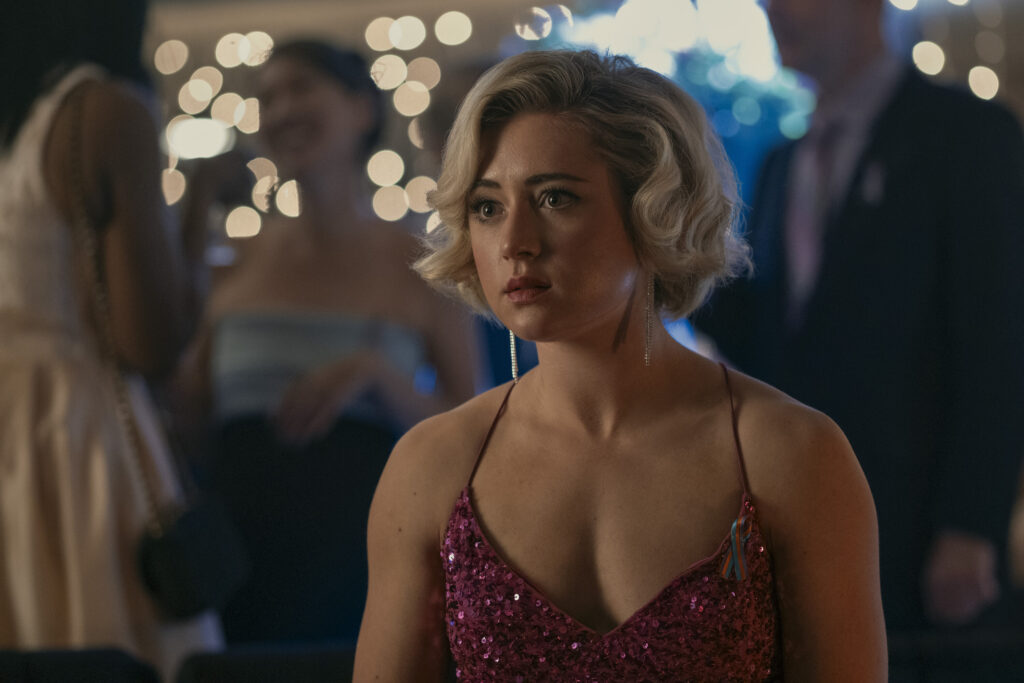
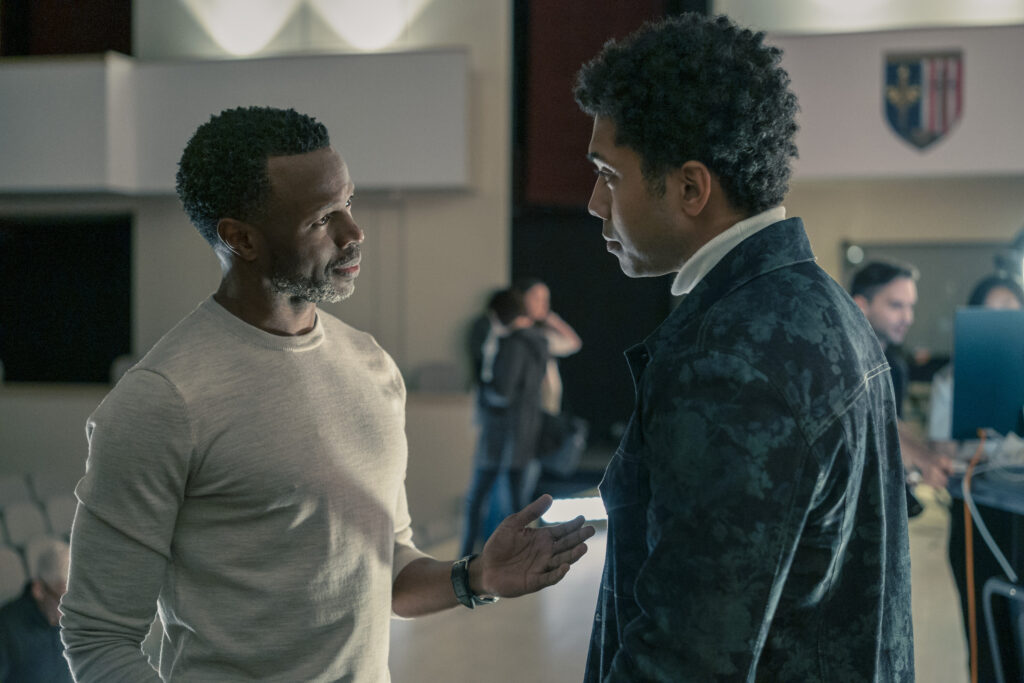
“How could Mom and Dad do that to us?”“They thought they were giving us powers.”“Well, I got a lot more than powers. I got a broken fucking brain!” Episode 3 kicks off with a flashback, taking us back to Sage Grove Center three years ago. We see Sam (Asa Germann), visibly agitated and upset over learning about Compound V. Luke (Patrick Schwarzenegger) calms down his little brother, we get an emotionally charged scene, emphasizing the brother’s love for each other. This scene turns out to be a flashback of Cate’s (Maddie Phillips) in the form of a nightmare, from passing from overusing her powers. Cate and Andre’s (Chance Perdomo) relationship takes an unexpected turn.   Meanwhile, Marie (Jaz Sinclair) rescues Emma (Lizze Broadway), who has pushed her powers to become tiny. They argue about their self-harming use of their abilities, each defending their actions as a demonstration of their power. Godolkin University plans a fundraiser and Vought strategizes to shape Marie’s image. Andre yearns to do something heroic. Emma’s overbearing mother enters the picture. Another flashback shows us the moment Luke learns about Sam’s supposed suicide three years ago. At the gala, Marie becomes the center of attention, while Emma faces exploitation from her mother and Vought. Emma and Marie’s friendship deepens as they share a heartfelt moment in the bathroom.  Emma and Jordan confront each of their parents’ ignorance and bigotry, tackling gender and mental health issues. Jordan’s “I’ve always just been me” quote was super powerful and London Thor’s delivery was excellent. Andre seeks Emma’s help in a dangerous mission and then confides in his dad, who reveals he’s aware of the sinister activities in “the woods”.  Emma and Sam meet and form a connection based on empathy and understanding and after learning the true reason for Emma being there, he agrees to be rescued. After learning about Indira’s exploitative intentions, Marie finally reveals the truth about her parents to Jordan and Cate, building their bond. The episode ends with Emma witnessing Sam’s torture. She tries to save him, but the security seemingly outnumbers them, leaving us on a gripping cliffhanger. #ThinkBrink skillfully delves into the theme of exploitation, shedding light on real-life challenges faced by many children and young adults. The show’s masterful use of the score and sound effects, particularly in the opening scene, stood out to me, as well as the continuous well-paced story building. What truly shines is the development of the characters and their relationships, which felt incredibly natural and organic and I’m genuinely excited to see where the show plans to take these characters in future episodes. One aspect that I, and I’m sure many fans of “The Boys”, particularly appreciate is how the show manages to connect both the main series and its spin-off. It subtly incorporates callbacks and references, such as a glimpse of the infamous ‘Love Sausage’ in The Woods and we even got a cameo from ‘The Deep’ (Chace Crawford).  Overall, Episode 3 is a must-watch and my favorite so far. It’s got relevant themes, great character development, and a story that keeps you excited for what’s next. Don’t miss it! -Mel

‘Gen V’ Episode 3 Review: “#ThinkBrink” Read More »

mv5bzdq2ywrhyzgtzmq5yi00yzewlwe1odgtzgmwnzcwm2u1mdblxkeyxkfqcgc@. v1

‘Gen V’ Episode 2 Review: “First day”

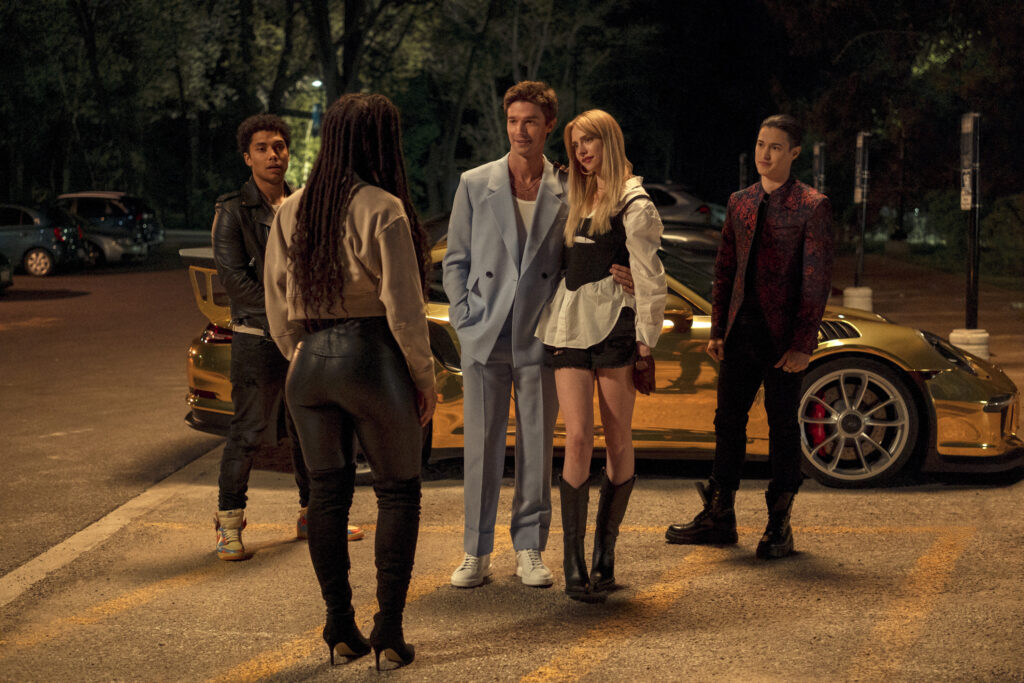
–This review contains spoilers for Episode 2 of Gen V- We return to Godolkin University. A tragic incident hallows above the school. Golden Boy blew himself up. No one truly saw it coming. After all, he was promised to join the Seven. His sudden death plays a role in what the season seems to unfold. The secret behind “the woods.” The episode starts off with another music choice that left me hooked. Phoebe Bridgers, covering “Nothing else matters”, while a team clears out the remains of Golden Boy. It’s a scene that could’ve been right out of The Boys.  Episode two tries to build up the character around Marie. We get a closer look at Cate, who grieves for her boyfriend and may have a clue for the investigation on the woods. Meanwhile Vought wants all the budget they have invested in Golden Boy to go to another student that can take his place in time.  We at last get a look at a familiar character and meet Ashley (with a full head of hair!). Complaining to Indira, the new dean of Godolkin University, about what she’s supposed to do with all the merch she had on golden boy. Urging the people at Godolkin to push Andre Anderson and Marie Mareau up to the top 10. Andre is expected to fully take over Golden Boys’ spot. In this scene we get another hint to the infamous woods, with Ashley mentioning how an exposure would cause “a fatal problem” for Vought.  Indira seems to take a special interest in Marie, although her real intentions remain unclear. She makes her attend photoshootings, interviews and turns Marie to the first Freshman who’s ever been in the Schools Top 10. What the audience finds out – what the characters aren’t aware of yet – is that she also plays a huge role behind the secret of the Sage Grove Center or as the friend group calls it: the Woods.  Cate and Andre question the school’s involvement in Luke’s death. They find out that Lukes little brother Sam has been kept under the grips of the Sage Grove Center for years, while his relatives were told that Sam died a long time ago. Cate and Andre ignore every other obligation and turn Sam to a new priority in order to honor Luke’s last wishes. Meanwhile Maries roommate Emma opens up about the secret behind her superpower to a girl she entrusted in class. Getting backstabbed by the same person, Emma’s story gets taken advantage of to boost the classmate’s social media accounts.  The episode does a great job in establishing the characters we briefly met in Episode 1 and turning them into their own people. By the end of it, the people around Marie had so many facettes that they became exciting. While watching, I sometimes completely forgot about other subplots, because I was so hooked on what was happening right now. Although it does add more depth to the other characters, Marie sadly falls a little flat here. We find out that her main intention behind all of this, is gaining her sister’s trust back and being able to see her again – once it’s clear that this may not happen, the morals she has established start to turn gray.  The overall theme of the episode plays with our generation’s addiction to social media and does a great job of highlighting its consequences, like feeling the need to get more and more likes and positive feedback. Following the social criticism, toxic “faux” mental health positivity gets a reality check by pointing out the hypocrisy of only bringing attention to it when something terrible happens. Despite the episode’s few flaws, Gen V still has a strong start, beating many preceding spin-offs.

‘Gen V’ Episode 2 Review: “First day” Read More »

Review: Fincher’s Latest Film Delivers a Gripping Tale of a Flawed Assassin

An Intro with an eerie tone. We see weapons. Pictures of a crime. Tension. The newest David Fincher film ‘The Killer’ premiered at the 80th Venice Film Festival upon its release on Netflix this October.  We meet Michael Fassbender as ‘The Killer’. He’s a lonely assassin. Spends all day sitting in an empty apartment. Waits for his target. Plays the Smiths. Does Yoga. Plays the Smiths again.  He is cold hearted and has his principles. No empathy. No remorse. He never misses. Until he does. After messing up a target he must escape. The Hunter becomes the hunted. His conclusion: he must get rid of those who might come for him first.  The editing in this is marvelous. While the film is slow and takes things step by step, the editing somehow feels faster paced. You cannot look away. Every shot feels thought out. There isn’t a lot happening, but when it does, it gets its audience’s fullest attention. ‘The Killer’ also delivers daunting scenes that feel cruel (which is something you might expect from a Fincher film). But then again, we also have a few scenes that made the audience light up in a little nervous laughter. Questioning oneself whether it’s cool to laugh over what we see on screen.  We have a protagonist who seems cold-hearted. He isn’t charming. Not really relatable (I mean if he is to you, I’d be a little scared). He barely talks to other characters. He does talk to us though. In this way this felt very Dexter-esque, a Killer with a constant inner monologue. Minus the charm Dexter, for example, had to offer. Nevertheless, the inner monologue makes us understand him and his actions as well. We get why he mentions his own rule book repeatedly. There are many scenes where we understand that he certainly isn’t as cold as he thinks he is. Even in the beginning when he misses his target, we see him doubt himself.  The sound design is haunting and something you may expect from a Fincher film. The fight scenes we see here, especially a certain one with a Bodybuilder are so fun to watch because they’re so well executed.  This feels more like a character study. To me, sadly, I didn’t quite get warm with him. I didn’t expect him to be an empathetic or relatable person, yet I somehow needed more to hold onto him. Care about the assassin we follow along for 118 Minutes. Nonetheless, this is incredibly well done. Michael Fassbender does an excellent job at playing our Killer and maybe if you stop trying to take his character serious and realize he’s doubting himself, it’ll become way more fun to watch. One thing I can agree on with our Killer here, is that the Smiths truly rock.  Overall, I think we can all agree that Fincher truly remains to be the master of suspense. (And now that the Killer is almost out and brings Fincher back to the crime scenes. I must do my duty here and ask Mr. Fincher to finally work on a third Season of the Mindhunter.) 

Review: Fincher’s Latest Film Delivers a Gripping Tale of a Flawed Assassin Read More »

Review: Sofia Coppola’s ‘Priscilla’ Shines a Needed New Light on Elvis Presley

Love me tender, love me sweet, never let me go… Just a year after Baz Luhrman’s ‘Elvis’ (starring Austin Butler) we get a whole different take to this story that throws the narrative Luhrman created upside down.  Sofia Coppola’s newest film ‘Priscilla’ premiered at the Venice Film Festival last night and received a flood of positive reviews. I loved it and I hope you stick with me to tell you why.  Now, Coppola is known to create incredible stories about women. Freeing privileged women from grips. Coppola is also excellent in creating intimacy and capturing human emotions in slow films very well. She’s been at the festival before in 2003 for her screening of ‘Lost In Translation’. With ‘Priscilla’ she dared to write a screenplay that wasn’t for Elvis fans, rightfully so. It questions the relationship 14-year-old Priscilla had with the then already established Rock n’ Roll icon Elvis Presley.  The film looked like what being in love as a teen felt like. All colored in Cotton Candy Colors.  We meet the great Elvis Presley out of Priscillas POV in a military base camp in West Germany. She’s staying with her parents. We see her do homework at a diner until she gets interrupted by older men who approach her and ask her if she wants to join a party. They say they’re friends with Elvis. She must’ve heard of Elvis, right? We see a young girl, introduced to a famous figure she’s in awe of.  Elvis Presley here is played by Jacob Elordi. Some of you might be familiar with his breakout role as Nate Jacobs in Euphoria.  Cailee Spaeny plays young Priscilla. Something that will immediately get the spectators attention is the immense height difference the characters have. Considering that they had a 10-year age gap when he met teenage Priscilla. The image of seeing a tall Jacob Elordi as Presley in front of a much smaller Spaeny in the role of Priscilla, is something that tells a lot without saying it out loud. Especially given that in the scene right before she met him, we see her choose outfits with her mother.  Both Actors did a really good job. Spaeny captures the silent pain Priscilla felt in her relationship so well: nodding, accepting, hoping it might change, while also loving the man she fell in love with back in Germany. Elordi plays the charming but troubled Elvis so well, making the audience understand his actions, but never pity him.   Coppola does not back away to picture Elvis as a turbulent, abusive, manipulative, and insecure man. At the same time, she manages to capture the love he tries to give, and the love Priscilla is feeling in all of this. The relationship is wrong in so many ways, yet the audience gets told why she stayed for so long. It has been a while since I saw an audience gasp together when seeing a man who was adored by so many shed in a different light: telling Priscilla how to wear her hair, how to do her makeup, criticizing her dresses or having outbursts of anger when she does not agree with him.  Priscilla is a story that is important to tell and a film that is important to see, especially to those who’ve seen the romanticized view on Elvis by Baz Luhrman a year before. Maybe this could be a wake-up call for those who refused to listen to Priscillas POV for so long… -Rue

Review: Sofia Coppola’s ‘Priscilla’ Shines a Needed New Light on Elvis Presley Read More »

Review: Yorgos Lanthimos’ ‘Poor Things’ Showcases Emma Stone’s Tour de Force Performance

“Cheese to meet you” Yorgos Lanthimos’ newest film, ‘Poor Things’ had its premiere in Venice last night, and it truly turned out to be one of the festival’s highlights so far. The Film revolves around the curious Bella Baxter (Emma Stone) who was brought to life by London’s brilliant scientist Godwin ‘God’ Baxter (Willem Dafoe). He took her in and offered her a home. Explained the world to her and became a parental figure. At the same time, he is keeping her past and her origin a secret. When his student Max McCandless (Ramy Youssef) develops feelings for Bella and agrees to marry her, her adventurous and curious mind takes her to discover parts of the world with Lawyer Duncan Wedderburn (Mark Ruffalo) instead.  The screenplay was written by Tony McNamara, who already worked alongside Lanthimos for ‘The Favourite’. ‘Poor Things’ is funny, intelligent and offers a truly empowering female character who challenges the patriarchic structures of our world.  Everything down to the Production is a masterclass in filmmaking. ‘Poor Things’ offers gorgeous visuals, making this feel like a novel you just cannot put down. The runtime of over 2 hours is barely noticeable.  The film can be utterly eerie and, in many ways, – without saying too much – also very disturbing (which shouldn’t be a surprise for those of you who are familiar with Lanthimos filmography). Nonetheless, it manages to discover emotions, thoughts and processes that make us all human and thematizes growing up and reflecting our world in a very fascinating and original way.  The cast is astounding. Emma Stones is already a talented actress, but this is truly one of the best performances she has given so far. Bella Baxter is adorable and her character development is fascinating to experience. Noticeable is that through the naïve eyes of Bella, we experience an almost Barbie-esque feeling. In many ways it reminded me of Gerwig’s film. Stones’ character asks the right questions, no one else would dare to ask and never accepts things that do not feel right to her. While power-driven men are brought to the edge of sanity, Bella outgrows naivety and becomes a remarkable and self-confident person. Perhaps one of my favorite Female Characters in a long time.  “Poor Things” is a film that should be seen on a big screen. Although it sadly may take some more time until its release due to the current SAG and WGA-strike.

Review: Yorgos Lanthimos’ ‘Poor Things’ Showcases Emma Stone’s Tour de Force Performance Read More »