
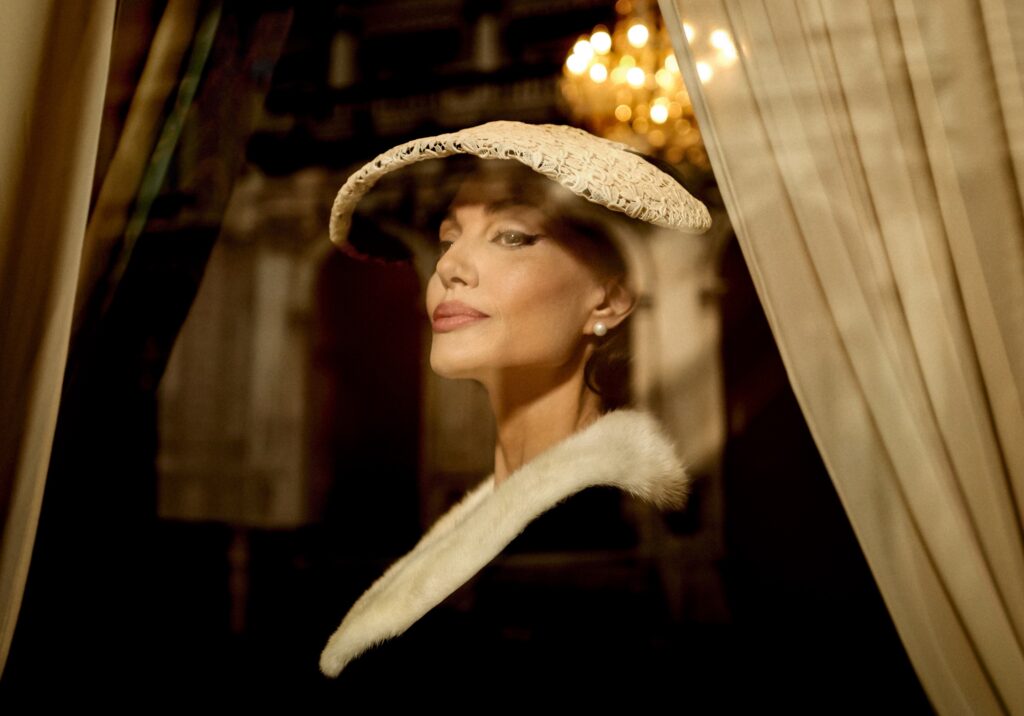
She stands on the stage. Holding her hands. Her eyes in the distance. “I heard Maria but not La Callas” says the pianist. Subtle Tears. A clenched jaw. A failure for her. One that does not seem to feel as tough for the pianist. But the end of the world for the opera singer who gave it all to be where she was.
In ‘Maria‘, Pablo Larraín delves once again into the tragic, confined world of iconic women. After exploring the lives of ‘Jackie’ (2016) and ‘Spencer’ (2021), he now offers a poignant exploration of Maria Callas’s final days. The film premiered at the Venice Film Festival last week and had its first screening at the Telluride Festival a few days ago. We managed to attend a screening in Venice and it is fair to say: we might see this one again at this upcoming Award Season!
Angelina Jolie, steps into the shoes of the legendary soprano and delivers a performance that is as haunting as it is subtle. She doesn’t just mimic Callas; she inhabits her, channeling the deep sadness and vulnerability that lurked beneath the diva’s towering presence. The perfect choice to play such a divine figure in the world of opera.
Larraín frames’Maria’ as a journey through the soprano’s mind, blending reality with the dreams and nightmares of her past that haunt her. Similar as he did in ‘Spencer’ Lorrain aims to discover a specific time to showcase and explore a feeling rather than tell a linear story.
The film was written by Steven Knight (2020) and opens with the final scene of the film. It’s 1977. We stare at an apartment in Paris. The year Callas lost her life. A small crowd is gathering around a body. Then a rewind. We jump by a week and follow Callas through her final days. The film becomes less about biographical accuracy and more about capturing the emotional truth of Callas’s inner world. We get to grasp the perfectionism the singer struggled with. The critique that got to her and the pressure she might have had in her final days. The narrative unfolds like a fever dream, with scenes slipping between the present and past, real and imagined. This approach allows the audience to explore the psychological toll of a life spent in the spotlight, where personal tragedies are magnified.
The film’s visual style mirrors this imaginative, almost surreal approach. Larraín captures 1970s Paris with a sense of nostalgia, but there’s always an undercurrent of melancholy, as if the city itself is complicit in Callas’s decline. The scenes in her apartment, where she paces and reflects, are particularly powerful, serving as a physical manifestation of her isolation and despair.
However, ‘Maria’ is not just a portrait of Callas—it’s also a commentary on the nature of stardom and the toll it takes on those who bear its weight. Jolie, with her own complex relationship with fame, is the perfect vessel for this exploration. There’s a sense that Larraín is drawing a parallel between the singer and the actress, both of whom have been shaped and scarred by the public’s relentless gaze.
In the end, Maria is as much about Angelina Jolie as it is about Maria Callas. It’s a film that asks us to look beyond the myth and see the woman behind the legend, to understand the cost of greatness. And through Jolie’s subtle, devastating performance, we do.