
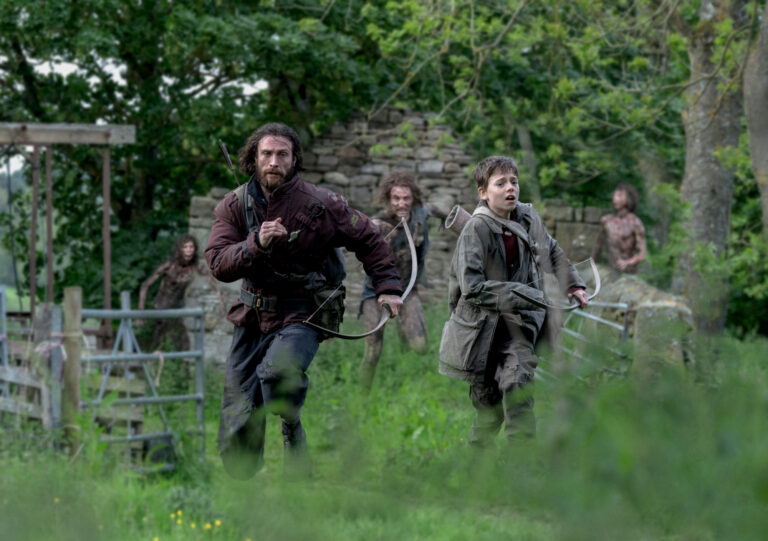
This installment veers away from the horrors and gore (though don’t you worry, not completely!), it instead leans more into epic storytelling. The tone is unmistakably different. more reflective, more emotional. At times, it feels more like a mythic sci-fi odyssey than a horror movie. That’s not a flaw, though. just like one of its key themes: it’s evolution.
the intro stood out to me the most when reflecting back on the film. there was a moment of imagery, references of real life events, that mirror the themes of the story. that was truly powerful and jarring.
Visually, 28 Years Later is breathtaking. Shot across the stark, lonely beauty of Northumberland, the cinematography is nothing short of gorgeous. The color grading leans bright and colorful, reminiscent of 2010s dystopian dramas. This contrast between the grim narrative and the vibrant world makes for a memorable and nostalgic aesthetic.
Character and world-building are where the film truly shines. The focus is on humanity and how fragile it can get. This is where Boyle and Garland’s collaboration hits hardest. There’s poetry in the storytelling and The soundtrack is emotionally charged and super intense, just as we know it as a highlight from the previous films. Some of the fight sequences have a stylized, video-game quality which is surprisingly effective, especially in scenes where arrows hit the infected. the bold camera movements and effects that are being used feel fresh and innovative.
And the cast? Excellent. Alfie Williams, the young newcomer, is an absolute revelation. His performance is so raw and powerful, it anchors the film emotionally in a way most zombie movies never even attempt. Jodie Comer delivers a heartbreaking and at the same time, heartwarming performance. Edvin Ryding, in a brief but memorable role, brings unexpected comedic relief. Aaron Taylor-Johnson and Ralph Fiennes bring weight and intensity, while it also feels like especially the former, felt a bit under-used.


Not everything lands perfectly. The CGI can be a little distracting, especially early on, but it’s something you adjust to as the story pulls you in. The ending, which hilariously reminded me a little of Twilight, is a curious choice and maybe divisive, but it definitely kickstarts what will be a fascinating trilogy.
Verdict:
28 Years Later is a bold reinvention. Less horror, more human. It’s deeply cinematic. The emotional depth, visual storytelling and philosophical undertones make it one hell of an exciting start to the new trilogy.