
In 2019, Todd Phillips’ Joker emerged as a cinematic phenomenon, earning widespread acclaim and a slew of accolades, including the prestige Golden Lion at the Venice Film Festival and an Oscar for Joaquin Phoenix’s haunting portrayal of the misunderstood loner Arthur Fleck. The film’s exploration of societal neglect and mental illness resonated deeply with audiences, propelling it to over $1.1 billion in global box office revenue. Proving that it wasn’t just another comic book movie, but a character study steeped in psychological and social commentary.
As anticipation for the sequel mounted, Phillips returned to Venice in 2024 with Joker: Folie à Deux, a follow-up that aims to build on the original’s success while venturing into new narrative and stylistic territory. The film picks up where the original left off. Arthur Fleck (Phoenix), now firmly entrenched in the grim confines of Arkham Hospital, faces a high-profile murder trial for killing talk-show host Murray Franklin. His attorney, Maryanne (Catherine Keener), argues that Arthur’s mental state should exempt him from the death penalty, proposing that his crimes were committed under severe psychological distress. However, the Gotham City district attorney, Harvey Dent (Harry Lawtey), contends that Arthur’s actions are the result of a deeply rooted personal malady.
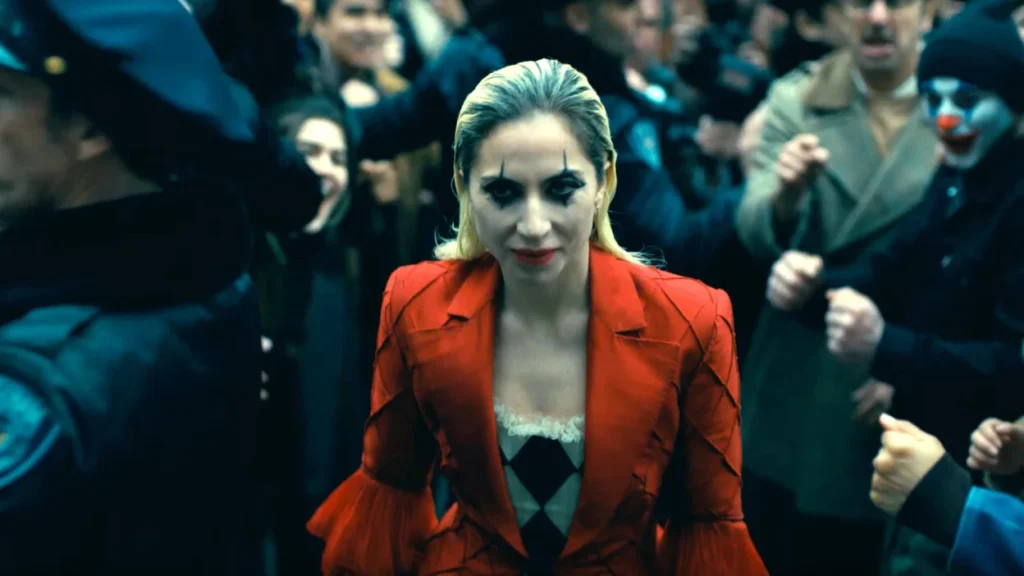
The film also introduces Harleen ‘Lee’ Quinzel (Lady Gaga), a fellow inmate at Arkham who becomes infatuated with Arthur. Lee’s fascination with Arthur grows as she sees him not just as a criminal but as an enigmatic figure. Their complex relationship forms the crux of the sequel, raising questions about whether Lee’s affection is genuine or driven by her own psychological issues.
The narrative treads the fine line between Arthur’s dual personas—the fragile man and the dangerous Joker—raising questions about Lee’s motivations. Does she love Arthur, or is she in love with the Joker?
Unfortunately, it falters when trying to explore these psychological dynamics, often losing narrative momentum.
One of the most striking features of Folie à Deux is its incorporation of musical numbers. This departure from the original’s bleak realism into a musical format is both bold and risky. The film opens with a Looney Tunes-inspired animation sequence designed by Oscar-nominated animator Sylvain Chomet, setting the stage for a film that blends dark themes with unexpected musical elements.
Phillips’ bold choice to incorporate musical numbers into the film is intriguing, but uneven. Gaga, known for her musical prowess, shines in these moments, delivering soulful renditions of classics like “(They Long to Be) Close to You” and “Gonna Build a Mountain.” However, these interludes, while well-executed, often feel disjointed from the film’s primary narrative. The transitions between dramatic scenes and musical numbers can be jarring, and the integration of these elements into the plot lacks cohesion.
Phoenix’s portrayal remains as compelling as ever, capturing Arthur’s deteriorating mental state with nuance. However, the sequel struggles to add new dimensions to his character, often revisiting familiar themes without offering significant new insights.
Lady Gaga’s performance as Lee Quinzel may be one of the film’s most anticipated elements. Gaga brings a palpable intensity to her role, creating a character who is both intriguing and unsettling. But unfortunately, the relationship between the characters which should be a central element to the film, lacks the emotional depth that is deemed necessary to fully engage the audience. Also the cast addition and the fact that the film has actors like Brendan Gleeson as Jackie, a prison guard with a fondness for Arthur, feels ultimately underutilized. Gleeson’s character could have added more depth to the story if given a more substantial role or a deeper connection to Arthur. To add more nuances to the characters.
The film offers glimpses of what it could’ve been like if certain scenes would’ve been explored a little deeper but unfortunately it constantly moves on too quickly. It is undeniably ambitious, seeking to balance psychological depth with musical flair, but often falls short of fully blending both elements. Arthur’s character, who had such a poignant arc in the first film, seems to stagnate here, repeating familiar beats without breaking new ground.
Despite these shortcomings, ‘Folie A Deux’ has its moments. The cinematography, by Lawrence Sher, and the score, composed by Hildur Guðnadóttir, evoke the same gritty, melancholic atmosphere of the original. Phillips also delves into darker social commentary, this time focusing on society’s fixation on notorious criminals. Yet, while the film tackles relevant themes, it lacks the visceral impact of its predecessor.
One of the most glaring issues is the chemistry—or lack thereof—between Phoenix and Gaga. While Gaga brings an unhinged intensity to her role, their romantic subplot fails to ignite the screen. Their scenes together, both in dialogue and song, lack the emotional depth necessary to make the audience care about their relationship. However, the sequel struggles to add new dimensions to the characters, often revisiting familiar themes without offering significant new insights.
Folie à Deux continues to delve into themes of societal failure and mental illness, but it does so with less impact than its predecessor. The film’s attempt to explore the duality of Arthur’s persona—between the sensitive man and the malevolent Joker—is intriguing but not fully realized. The courtroom drama at the film’s core struggles to maintain momentum, and the narrative sometimes feels bogged down by its own complexity.
The film also grapples with its own legacy and the expectations set by the original Joker. By distancing itself from traditional comic book elements and focusing on a more character-driven story, Folie à Deux aims to redefine the Joker mythos. This approach is commendable, but the execution falls short of the original’s emotional and thematic impact. Phillips attempts to distance the sequel from its comic book origins, even omitting the DC logo. Still, Arthur Fleck’s character is undeniably tied to the Joker mythos, raising questions about whether this shift is intentional. Is Phillips trying to shed the fanbase that misunderstood the first film, particularly those who viewed Joker more as a Hero?
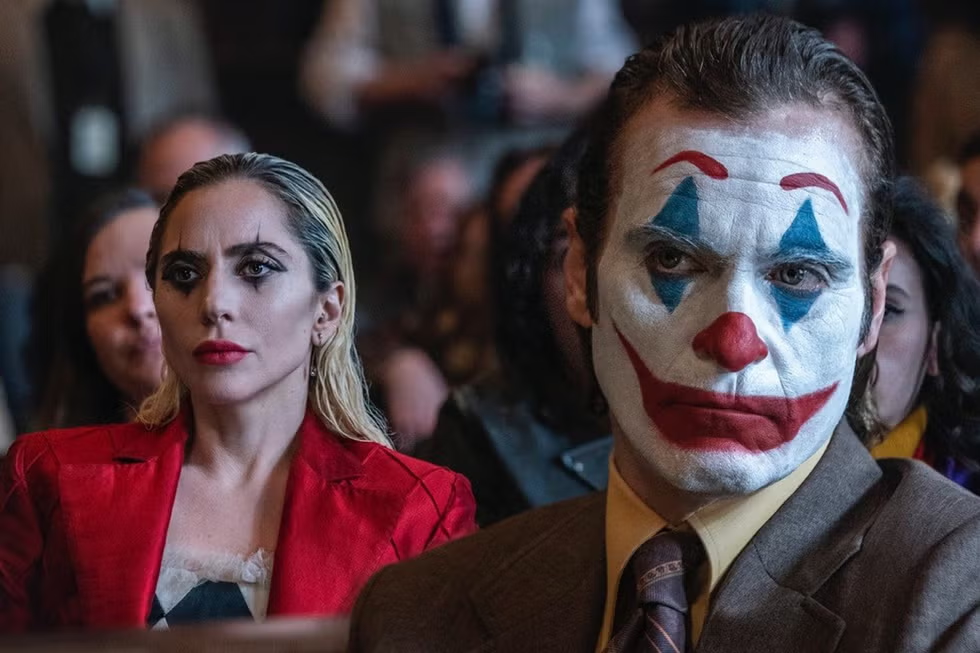
Ultimately, Joker: Folie à Deux is a film that strives to push boundaries but often stumbles in its execution. It doesn’t have the same emotional heft as the original, and its musical elements, while daring, don’t fully resonate with the darker narrative. Despite strong performances from its leads, particularly Gaga’s, the film struggles to find the same balance between character study and spectacle that made the first one so compelling.
Joker: Folie à Deux is a film that ambitiously seeks to expand on its predecessor while exploring new stylistic and thematic ground. The integration of musical elements adds a unique twist, but the film often struggles with its execution, leaving the narrative feeling disjointed. Phoenix’s performance remains a highlight, though it lacks the transformative power of his previous portrayal. Gaga’s role is captivating but not enough to fully anchor the film’s central relationship.
While the sequel offers some thought-provoking moments and maintains a certain level of intrigue, it ultimately fails to capture the same raw intensity and emotional depth that made the original Joker so impactful. Folie à Deux will likely resonate with fans of the first film and those curious about its musical experimentation, but it may not stand as a worthy successor to the groundbreaking original.